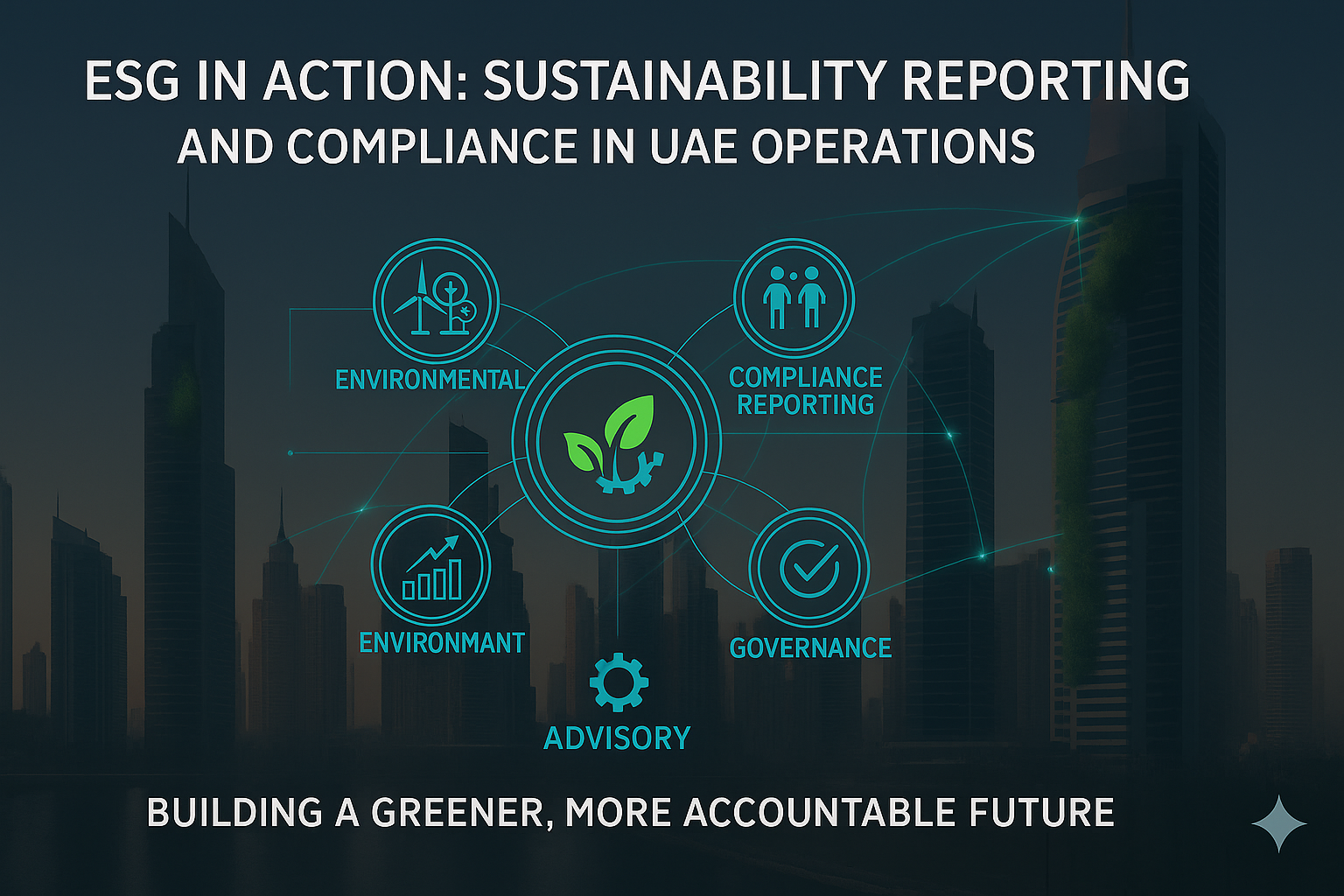
In the UAE, Environmental, Social, and Governance (ESG) priorities have shifted from “good to have” to non-negotiable business requirements. What started as voluntary CSR has now evolved into strict compliance obligations with real financial, operational, and reputational consequences.
With the UAE Federal Climate Law (effective May 30, 2025), all UAE businesses must measure and report greenhouse gas emissions—and face penalties up to AED 2 million for non-compliance. Simultaneously, the Securities and Commodities Authority (SCA) mandates annual sustainability reports for listed companies within 90 days of year-end.
This guide explains how UAE businesses can build an ESG strategy aligned with regulations, strengthen governance, and embed sustainability into operations. Whether you're a manufacturer, logistics provider, trading company, or professional services firm, ASC Global’s business advisory services in Dubai help transform ESG from a compliance burden into a strategic advantage.
Key Insight: Early ESG integration leads to lower regulatory risk, higher investor trust, easier capital access, and stronger long-term competitiveness.
Environmental:
Carbon emissions, energy use, water stewardship, waste management, biodiversity, and climate-related risks.
Social:
Labor standards, DEI (diversity, equity & inclusion), community engagement, health & safety, employee wellbeing.
Governance:
Board structure, anti-corruption policies, ethics, transparency, data governance, internal controls.
Businesses adopting ESG in the UAE experience:
Investor Reality:
91% of UAE issuers expect to significantly reallocate capital to environmental and social outcomes (HSBC Survey). Globally, $87 trillion in AUM relies on SASB-aligned ESG metrics.
Key national and regulatory drivers:
Effective: May 30, 2025
Applies to: All UAE-based entities (including free zones)
Penalty: AED 50,000–AED 2,000,000
Who must comply:
ADX/DFM listed companies
Applies to: Large ADGM-registered companies
(Turnover > USD 68M or AUM > USD 6B)
| Phase | Timeline | Key Actions |
| Immediate | Now – Q4 2025 | ESG governance, gap analysis, begin emissions data collection |
| Short-Term | Q1 – Q2 2026 | First ESG reporting for large emitters, integrate accounting with emissions tracking |
| Mid-Term | 2026 – 2027 | Data governance, dashboards, assurance readiness, supplier ESG alignment |
| Long-Term | 2027 onwards | Scope 3 planning, supply chain decarbonization, capital allocation alignment |
| Framework | Focus | Best For | UAE Relevance |
| GRI | Broad sustainability impact | Stakeholder reporting | Mandatory for SCA-listed companies |
| SASB | Financially material metrics | Investor-facing disclosures | Growing adoption |
| TCFD | Climate risks & opportunities | Lenders, risk committees | Rise in climate-exposed sectors |
| ISSB (IFRS S1/S2) | Global baseline | International investors | Expected regulatory baseline by 2028 |
Tip: Most UAE companies integrate GRI + SASB + TCFD for comprehensive coverage.
ESG is no longer optional for UAE businesses—it's a regulatory requirement, investor expectation, and long-term competitive advantage. With the UAE Federal Climate Law taking effect in 2025, mandatory sustainability reporting from SCA, and rising pressure from global supply chains, companies that invest in ESG readiness now will be better positioned for growth, financing, and market leadership.
Whether you need help with emissions measurement, governance frameworks, GRI/SASB/TCFD alignment, or building a complete ESG roadmap, expert guidance ensures your business stays compliant, credible, and future-ready. Partnering with an experienced advisory team not only reduces compliance risk but also unlocks new opportunities—sustainable finance, stronger reputation, and improved investor confidence.
📞 Call: +971503287722
💬 WhatsApp: https://wa.me/971503287722
🌐 Visit: www.ascglobal.ae
📩 Email: info@ascglobal.ae
ASC Global UAE — your trusted partner in M&A advisory, integration, ESG compliance, and growth acceleration.
Q1: When does the UAE Federal Climate Law apply?
A1: Effective May 30, 2025 — applies to all UAE businesses.
Q2: Must non-listed businesses report ESG?
A2: Yes—Federal Climate Law applies to all. ADGM imposes additional requirements. Non-listed firms also face contractual ESG demands from banks and partners.
Q3: Which framework should I choose?
A3: Listed entities must adopt GRI. Others can combine SASB + TCFD + ISSB for investor-grade reporting.
Q4: How does risk advisory support ESG?
A4: By aligning climate risks with capital planning, financing strategy, board oversight, and governance.
Q5: What ESG data should I prioritize first?
A5: Energy, emissions (Scope 1/2), water/waste, workforce diversity, H&S, governance structure, ethics controls.
Q6: How to transition to mandatory ESG reporting?
A6: Governance → Gap analysis → Data systems → Reporting → Assurance → Supplier integration.
Q7: What are the consequences of non-compliance?
A7:Fines up to AED 2M, loss of contracts, reputational impact, higher capital cost.
Q8: How does ASC Global help?
A8: ASC provides end-to-end ESG strategy, compliance, reporting, data governance, decarbonization planning, and assurance support.
Q9: Common ESG mistakes?
A9: Greenwashing, incomplete data, no materiality assessment, wrong framework, weak governance.
Q10: How does ESG impact financing?
A10: Stronger ESG = better credit terms, access to green financing, lower interest rates, investor confidence.
 Business Advisory
Introduction: Preparing for the Evolving ESG Reporting Landscape in the UAE The UAE's commitment to sustainability is ra...
Read More
Office 04 - 1803, 18th floor, One by Omniyat Business bay, Dubai
302-18 Edgecliff Golfway, North York, Toronto, Ontario M3C 3A3
Via F.lli Gabba 3, 20121 – Milan, Italy
RM2106, Huishangsha Edifice, No.37, Baoshi West RD, Shiyan Town, Bao’an District, Shenzhen - 518108, China
C-100, Sector 2, Noida (UP), Delhi NCR, India 201301
One Raffles Place, Tower 1, 27-03 Singapore - 048616
 Merger & Acquisition
 Due Diligence
 Business Advisory
 Business Setup & PRO
 Corporate Tax Advisory
 Accounting & Assurance
 Risk Advisory
 Tech & Cyber Security
 VAT Advisory